Business owner planning
Your business is probably the largest position you own. We plan the owner’s side of it: how you are paid, what the entity does to your taxes, which retirement plan fits, and what the exit looks like before it arrives.
Talk with Joseph
Plan the owner’s side
Paying yourself from an S corporation
Structure how you are paid
Salary, distributions, guaranteed payments and retained earnings each land differently on your return and on your retirement plan limits. We model the compensation mix against the entity you have, the qualified business income deduction under section 199A and the payroll tax line, then revisit it as the business grows.
Design the retirement plan
A SEP, a solo 401(k), a safe harbor plan and a cash balance plan can shelter very different amounts, and the right one depends on your age, your income and who else is on payroll. We size the plan to the bracket you are actually in and to the employees you actually have.
Know the exit before it comes
Basis, entity type, holding periods and the buyer’s likely structure decide what a sale nets after tax. For qualified small business stock the rules changed in 2025. We keep the exit modeled while there is still time to change what it will look like.
Common questions
Should my business be an S corporation?
Sometimes. The election trades payroll tax on distributions for a reasonable compensation requirement, and it interacts with your retirement plan limits and the section 199A deduction. We model the entity choice as a whole, and your preparer handles the election and the return. Valerio Wealth Management does not prepare business or personal tax returns, does not file entity elections, and does not represent clients before the IRS.
How much can I actually put away for retirement?
Usually more than a SEP allows, once the plan is designed around your age and payroll. A solo 401(k) adds the employee deferral, a safe harbor plan handles employees, and a cash balance plan can layer a large deductible contribution on top for owners with steady profit. The plan is sized to your bracket, not to a rule of thumb.
I am years from selling. Why plan the exit now?
Because the largest levers have holding periods. Qualified small business stock treatment, basis, the entity itself and the terms of a buy-sell agreement all take years to put in place. Planning the exit early is what makes the eventual sale a choice rather than a scramble.
How should I be paying myself?
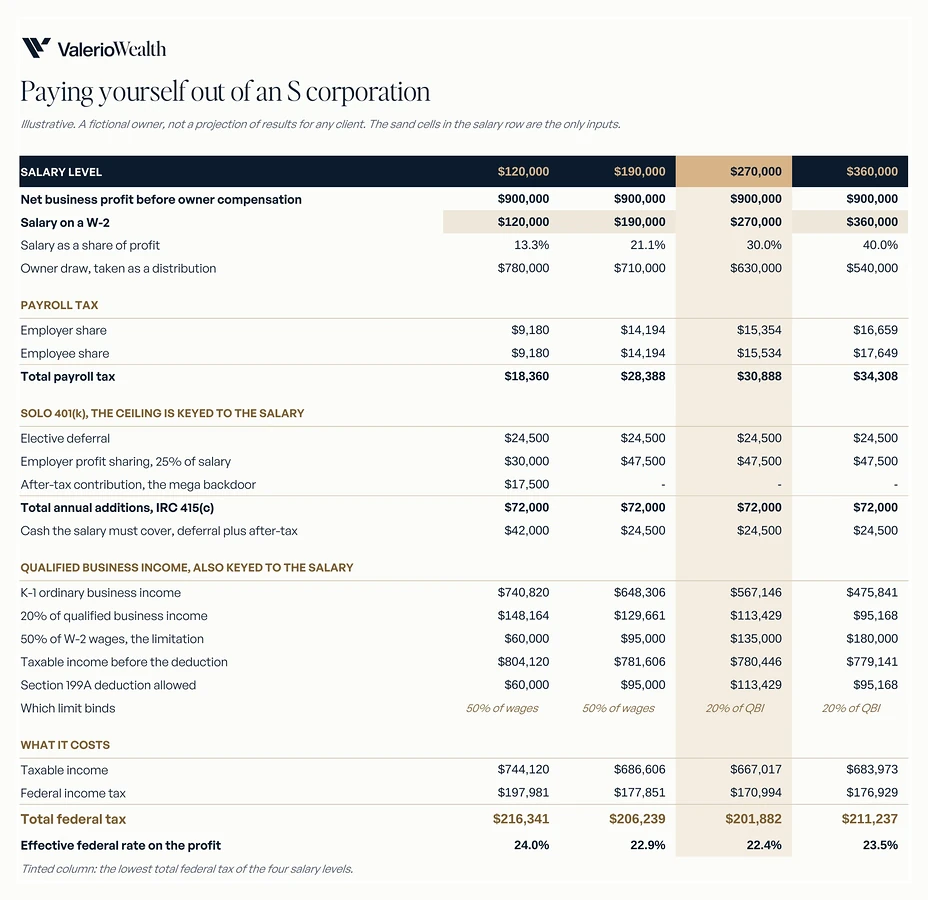
The entity question is rarely settled once. An S corporation trades payroll tax on distributions for a reasonable compensation requirement, and that salary figure then sets your retirement plan limits and, above the income thresholds, the wage limitation on the section 199A deduction. Push salary down to save payroll tax and the plan contribution shrinks with it. Push it up for the plan and the payroll tax follows. The right point is a computation across all three, and it moves as profit moves.
For owners who may sell one day, the C corporation is worth a fresh look. The 2025 law change expanded qualified small business stock under section 1202 for stock acquired after July 4, 2025: a tiered exclusion of fifty percent after three years, seventy-five after four and one hundred after five, a per-issuer cap of fifteen million dollars, and a gross asset ceiling of seventy-five million, both indexed from 2027.
Stock issued before that date keeps the older five-year, ten-million-dollar rules. Whether the entity should change to reach that treatment is a planning decision with a long lead time, and it has to be weighed against double taxation on operating income in the meantime.
Florida owners have no state income tax to plan around, which simplifies the return and complicates nothing else. What still needs attention is basis. An S corporation owner’s stock and debt basis determines whether losses are usable and whether distributions are taxable, and it is easy to lose track of over a decade of profitable years and occasional loans to the company. We keep it current, because the exit calculation starts there.
How do the retirement plan and the eventual sale fit together?
Most owners are told SEP because it is simple. A solo 401(k) adds the employee deferral on top of the employer contribution and usually shelters more at the same income. Once there are employees, a safe harbor design passes the deferral tests automatically in exchange for a set employer contribution, budgeted from the start.
For an owner over fifty with reliable profit, a cash balance plan can layer a large deductible contribution on top of the 401(k), and that is where the tax planning and the retirement planning become the same decision. The plan is designed to your bracket and your payroll, then funded on a schedule the cash flow can carry.
The exit is planned in reverse. An asset sale and a stock sale produce different after-tax results for the same headline price, and the buyer usually prefers the one that costs you more. Installment terms under section 453 spread gain across years and brackets.
A buy-sell agreement decides who can buy, at what price, and how it is funded, and the coverage behind it is part of the risk review. Family succession brings the estate plan into the room, with gifting and valuation questions that take years to execute well.
None of this replaces your accountant or your attorney. It gives them a client who arrives with the decisions made, the numbers modeled, and the timeline in hand.
What exactly is included?
- Entity choice analysis: sole proprietor, LLC, S corporation and C corporation, modeled after tax
- Compensation design: salary, distributions and guaranteed payments
- Qualified business income deduction planning under section 199A
- Retirement plan selection and design: SEP, solo 401(k), safe harbor 401(k) and cash balance
- Contribution timing and funding across the year
- Qualified small business stock planning under section 1202, including the 2025 tiers
- Stock and debt basis tracking for S corporation owners
- Estimated payment and cash reserve design for variable income
- Buy-sell agreement review and the coverage that funds it
- Exit modeling: asset versus stock sale, installment structures and after-tax proceeds
- Succession and family transfer planning, coordinated with your estate plan
- Coordination with your preparer and attorney at each step